




Advancing Rare Disease Diagnosis in Bulgaria Through Whole-Exome Sequencing and Molecular Genetics
Key Takeaways
- Medical University – Pleven and the Leonardo da Vinci Center of Competence demonstrate the clinical value of whole-exome sequencing in rare hereditary disorders affecting vision, hearing, and metabolism.
- Two patient-based genetic studies highlight how molecular diagnostics can resolve complex phenotypes initially interpreted as ophthalmological, metabolic, or acquired sensory disorders.
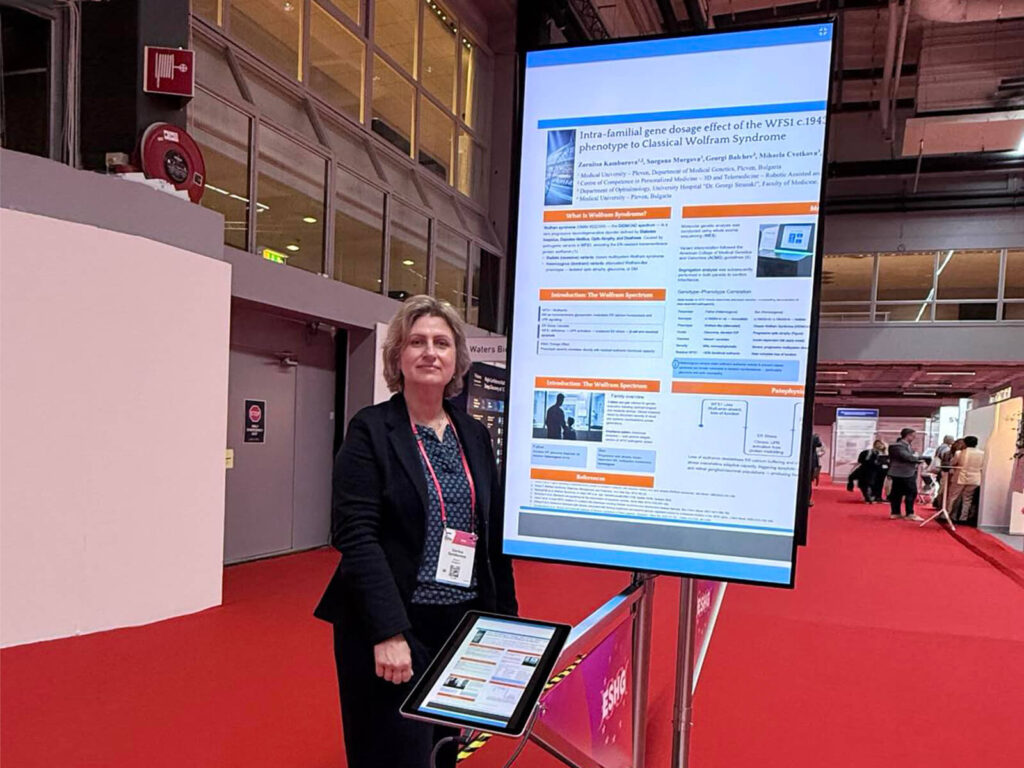
- A WFS1-related family case illustrates a clear intra-familial gene dosage effect: heterozygous carrier status associated with an attenuated Wolfram-like phenotype, and homozygosity associated with classical Wolfram syndrome.
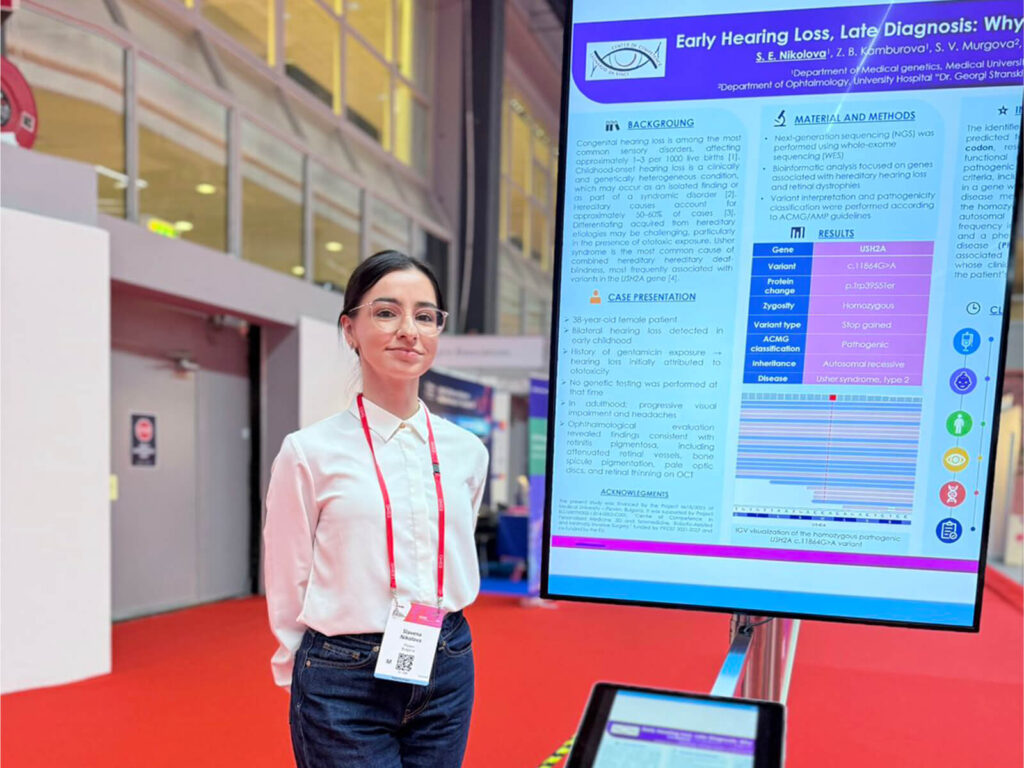
- A second case confirms Usher syndrome type 2 in a 38-year-old female patient with early bilateral hearing loss and later-onset progressive visual impairment, caused by a homozygous pathogenic USH2A stop-gain variant.
- The findings underline the importance of early genetic testing, multidisciplinary evaluation, and genetic counseling in patients with unexplained hearing loss, optic atrophy, glaucoma, retinitis pigmentosa, or syndromic sensory impairment.
In 2026, researchers and clinicians from Medical University – Pleven, University Hospital “Dr. Georgi Stranski” – Pleven, and the Leonardo da Vinci Center of Competence presented two clinically significant examples of how advanced molecular diagnostics can transform the evaluation of rare hereditary diseases.
The studies focus on two different but conceptually related diagnostic challenges: Wolfram syndrome spectrum disorders and Usher syndrome type 2. Both conditions involve progressive sensory impairment and require close collaboration between medical genetics, ophthalmology, endocrinology, audiology, and specialized clinical care.
The first study describes a father–son pair referred for genetic evaluation after ophthalmological and metabolic assessment. Molecular analysis by whole-exome sequencing identified the pathogenic WFS1 variant NM_006005.3:c.1943G>A, p.Trp648*. The father, who was heterozygous for the variant, presented with elevated intraocular pressure and glaucoma without classical systemic Wolfram syndrome. In contrast, the son was homozygous for the same variant and showed progressive optic atrophy, insulin-dependent diabetes mellitus, and multisystem involvement consistent with classical Wolfram syndrome.
This case provides a compelling demonstration of genotype–phenotype correlation and allelic dosage effect in WFS1-related disease. While biallelic loss of WFS1 function leads to the classical DIDMOAD spectrum — diabetes insipidus, diabetes mellitus, optic atrophy, and deafness — heterozygous carriers may present with attenuated or partial manifestations, including optic neuropathy, glaucoma, or metabolic abnormalities.
The second study focuses on a 38-year-old female patient with bilateral hearing loss detected in early childhood. Because the patient had a history of gentamicin exposure, the hearing loss was initially attributed to ototoxicity and no genetic testing was performed at that time. Years later, the development of progressive visual impairment, headaches, and ophthalmological findings consistent with retinitis pigmentosa prompted further investigation. Whole-exome sequencing identified a homozygous pathogenic USH2A variant, c.11864G>A, p.Trp3955Ter, confirming the diagnosis of Usher syndrome type 2.
The case demonstrates a frequent diagnostic problem in clinical practice: the presence of an environmental risk factor may delay recognition of an underlying hereditary disorder. In patients with childhood-onset hearing loss, especially when visual symptoms appear later, syndromic hereditary disease should remain part of the differential diagnosis. Early molecular testing may shorten the diagnostic odyssey, guide surveillance, support reproductive counseling, and enable coordinated multidisciplinary follow-up.
Together, these two studies highlight the expanding role of genomic medicine in Bulgaria. By integrating whole-exome sequencing, variant interpretation according to ACMG/AMP criteria, segregation analysis, ophthalmological assessment, OCT findings, and clinical genetics, the teams in Pleven are strengthening the bridge between advanced diagnostics and real-world patient care.
The work also reflects the strategic mission of the Leonardo da Vinci Center of Competence: to translate research infrastructure, molecular technologies, and multidisciplinary expertise into clinically meaningful innovation for patients with complex, rare, and hereditary diseases.
Questions & Answers
What is the main message of these two studies?
The main message is that unexplained sensory impairment — hearing loss, optic atrophy, glaucoma, or retinal degeneration — should prompt timely genetic evaluation, even when an acquired explanation appears plausible.
Why is the WFS1 case important?
It shows how the same pathogenic variant can produce different disease severity depending on gene dosage. The heterozygous father had an attenuated Wolfram-like presentation, while the homozygous son developed classical Wolfram syndrome with optic atrophy, diabetes, and multisystem involvement.
Why is the USH2A case clinically relevant?
It illustrates that childhood hearing loss should not automatically be attributed to ototoxic exposure when later symptoms suggest syndromic disease. The diagnosis of Usher syndrome type 2 was confirmed only after progressive visual impairment and molecular testing.
What is the role of whole-exome sequencing?
Whole-exome sequencing allows simultaneous analysis of many genes associated with hereditary hearing loss, retinal dystrophies, optic neuropathies, metabolic disorders, and rare syndromes. This is particularly useful when the clinical phenotype is heterogeneous or evolves over time.
Why does this matter for precision medicine in Bulgaria?
These cases show that precision medicine is not limited to oncology. The same molecular diagnostic infrastructure can improve diagnosis, surveillance, counseling, and management for patients with rare hereditary diseases, strengthening Bulgaria’s capacity for modern genomic healthcare.

Usher Syndrome
PDF DOCUMENT
EP20.077
PDF DOCUMENT