


Telesurgery: When Surgical Expertise Reaches the Operating Room from a Distance
Key Takeaways
- In telesurgery, a surgeon controls robotic instruments from another location while the patient and a clinical team remain together in the operating room.
- Published procedures have demonstrated that this is technically and clinically feasible in selected cases. The evidence is growing, but much of it still comes from individual cases and small studies.
- Patient safety depends on more than a stable connection. The on-site team must be prepared to manage the operation and take over if necessary.
- Building on its experience in surgical tele-mentoring, the Leonardo da Vinci Center of Competence is preparing to explore the next step in remote robotic surgery.
From Tele-Mentoring to Telesurgery
In a previous article, we described a robotic colorectal operation performed in Pleven with real-time guidance from a surgeon in China. The patient and operating surgeon were in the same hospital. The remote expert observed the procedure, communicated with the team and provided guidance. That is tele-mentoring.
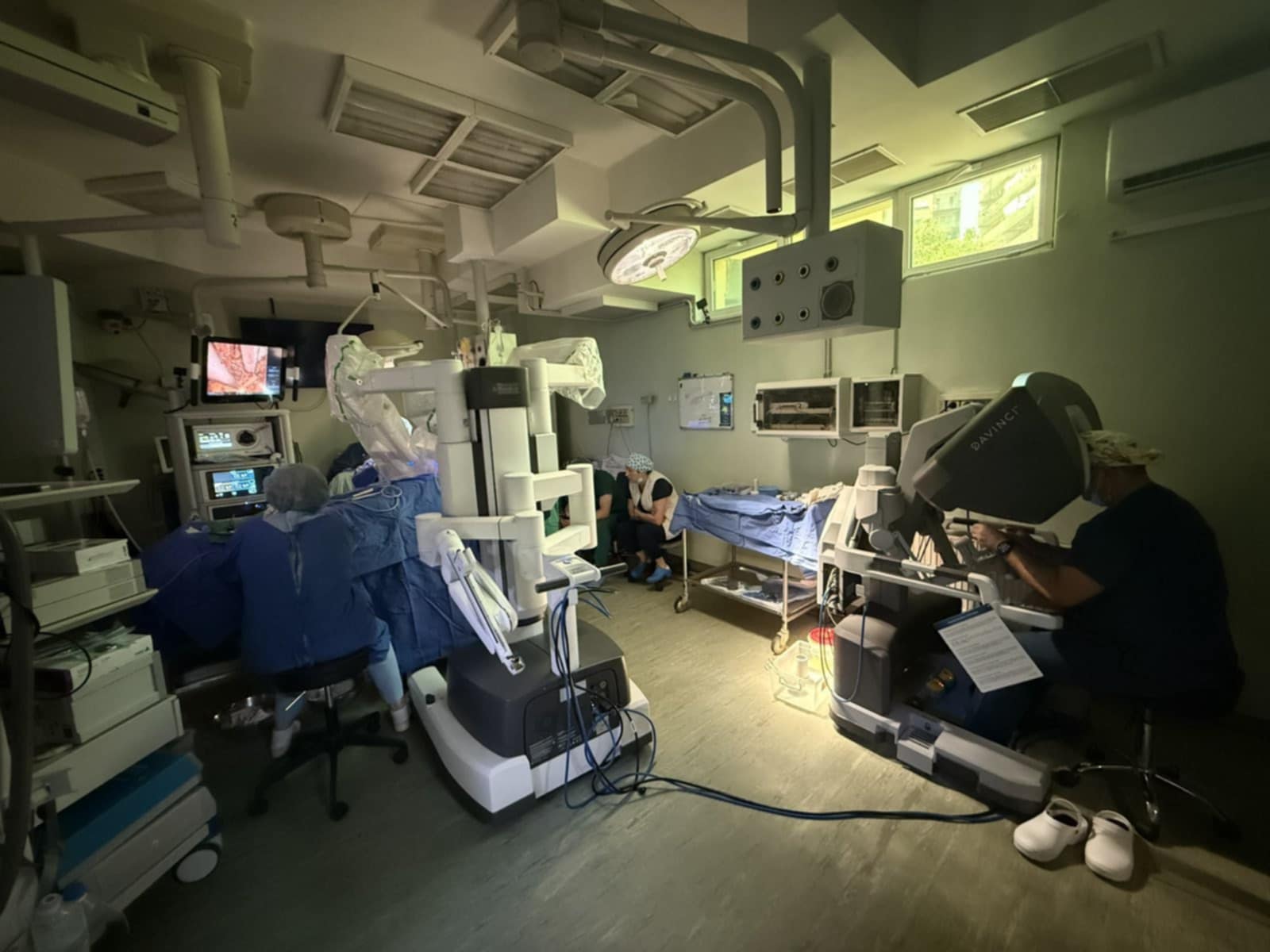
Telesurgery takes a further step. The surgeon at the remote console directly controls the robotic instruments. At the patient’s side, the surgical and anaesthesia teams continue to provide care, assist with the procedure and respond to any clinical or technical problem. The robot does not operate independently: every surgical movement is directed by a surgeon.
The distinction matters because remote control introduces an additional dependency. Alongside the usual demands of surgery, the team must account for the reliability of the connection between the console and the operating room.
An Idea with a Longer History Than Many Expect
Remote surgical control did not begin with today’s high-speed networks. In 1995, researchers in Milan reported a prostate biopsy performed using a robotic and telerobotic system. It was an early clinical application, although a biopsy is different from performing an entire operation remotely [1].
A more widely recognised milestone followed in 2001. Surgeons in New York performed a laparoscopic gallbladder removal on a patient in Strasbourg, France, using a dedicated telecommunications connection. Their published report describes a 54-minute operation with no complications and an average transmission delay of 155 milliseconds [2]. The case showed that a complete operation could be performed across an ocean under carefully arranged conditions.
The question since then has been how remote surgery can move from exceptional demonstrations to a dependable clinical process.
What Recent European Experience Shows
In 2025, a Belgian team published a case of robot-assisted remote hysterectomy using the Toumai Endoscopic Surgery System. The surgeon operated from one institution while the patient and the surgical team were approximately 20 kilometres away. The procedure was completed without an intraoperative complication or a need for the on-site surgeon to take over. The reported average connection delay was 20 milliseconds [3]. This was one patient’s experience, making it valuable evidence of feasibility while leaving broader questions about outcomes unanswered.
European experience has also expanded in urology. A 2025 research letter reported a remote robot-assisted radical prostatectomy using Toumai [4]. In August 2026, a prospective Belgian pilot study reported ten remote radical prostatectomies alongside ten matched procedures performed with the surgeon on site. All ten remote procedures were completed without an intraoperative adverse event or local takeover. One brief connection interruption occurred without clinical consequences [5].
These findings are encouraging, particularly because the pilot study recorded both clinical results and connection performance. Ten remote operations, however, cannot establish how often rare complications might occur or whether outcomes will remain comparable across different hospitals, teams and network conditions.
Teams in Spain have also publicly reported remote prostatectomies between hospitals in Madrid and between Belgium and Madrid, as well as a remote nephrectomy with the surgeon in Germany and the patient in Spain [7, 8]. These accounts illustrate clinical activity, but they are reports from participating teams, not substitutes for published studies with detailed methods and follow-up.
In gynaecological oncology, a 2026 conference abstract discusses the potential of remote hysterectomy while explicitly recognising the lack of large-scale data and standardised protocols [6]. It should be read as an account of an emerging field, rather than evidence that telesurgery has already established better cancer outcomes.
What Makes a Remote Operation Safe?
A low connection delay helps a surgeon control the instruments, but a single network figure cannot establish that an operation is safe. The reported 155 milliseconds in the transatlantic operation and 20 milliseconds in the Belgian hysterectomy describe different systems and circumstances. They are not universal thresholds that can simply be applied to a future procedure [2, 3].
Preparation has to cover the entire operation:
- Clinical selection. The procedure and patient must be suitable for the planned approach.
- Clear responsibilities. Everyone must know who is operating remotely, who is leading the team at the patient’s side and who will make decisions if circumstances change.
- On-site surgical capability. A qualified surgeon must be ready to intervene or take over according to a rehearsed plan. In the Belgian hysterectomy case, an active dual-console arrangement supported immediate on-site takeover [3].
- Tested communication. The team must check the control connection, surgical video and direct communication between locations, with a response plan for interruption.
- Patient information and governance. Consent, professional responsibilities, data protection and the applicable requirements for the specific procedure must be addressed before surgery.
The brief connection interruption recorded in the Belgian pilot study is a useful reminder: even when an operation is completed successfully, technical events need to be anticipated, monitored and reported [5].
Why Could Telesurgery Matter for Patients?
The potential benefit is access to surgical expertise without requiring every specialist to travel to every operating room. A remote surgeon could participate directly in a selected procedure while the patient receives anaesthesia, hands-on assistance and postoperative care at the local hospital.
That possibility should not be confused with a proven improvement in outcomes. Whether telesurgery provides a meaningful benefit will depend on the patient’s needs, the availability of local expertise, the quality of the surgical team and the results observed over time.
The Next Step for the Leonardo da Vinci Center
The Center’s work in robotic surgery, telemedicine and surgical education provides a foundation for examining remote operation. A potential telesurgical intervention would bring together clinical planning, team training, technical testing and careful evaluation of the result.
The model under consideration involves a remote operator who is already a surgeon within the hospital’s established team, with a surgeon present at the patient’s side to lead the on-site team and respond if direct intervention is needed. The precise responsibilities and arrangements would need to be confirmed for the specific procedure before it takes place.
The goal is to determine whether a carefully prepared connection can extend what an experienced surgical team can do for a patient while keeping responsibility and the capacity to act firmly in the operating room.
References
Scientific publications
- Rovetta A, Sala R. Execution of robot-assisted biopsies within the clinical context. Journal of Image Guided Surgery. 1995;1(5):280–287.
- Marescaux J, et al. Transcontinental robot-assisted remote telesurgery: feasibility and potential applications. Annals of Surgery. 2002;235(4):487–492.
- Pazzaglia E, et al. Pioneering telesurgery in gynecology: the first European case of total hysterectomy. Journal of Robotic Surgery. 2025;19:460.
- Beatrici E, et al. Pioneering European telesurgery: first robot-assisted radical prostatectomy with the Toumai® system. BJU International. 2025;136:810–812. Research letter.
- De Naeyer G, et al. Safety and feasibility of telesurgical robot assisted radical prostatectomy: prospective pilot study. BJU International. Published online August 2026.
- Pasquini P, et al. Feasibility of remote robot-assisted total hysterectomy: first experience in telesurgery for oncologic gynecology. International Journal of Gynecological Cancer. 2026;36(Suppl 1):103668. Conference abstract.
Reports from participating clinical teams
Q&A: Remote Robotic Surgery
What is the difference between tele-mentoring and telesurgery?
In tele-mentoring, a remote expert guides the surgeon who is operating beside the patient. In telesurgery, the remote surgeon directly controls the robotic instruments.
Is the patient alone with a robot?
No. The patient is in an operating room with an on-site surgical and anaesthesia team. The robot translates a surgeon’s commands into movements; it does not decide how to operate.
What happens if the connection fails?
The response must be planned and tested before surgery. Depending on the system and the situation, the on-site team must be able to secure the patient and take over the procedure when necessary.
Has telesurgery been proven as safe as conventional on-site robotic surgery?
Published cases and a small prospective pilot study provide encouraging early results in selected settings. The studies discussed here do not establish equivalent safety across all procedures, hospitals or patients.
What is the Leonardo da Vinci Center’s role?
The Center brings together expertise in robotic surgery, telemedicine, training and clinical research. Its next task is to assess how these capabilities can support a carefully planned remote surgical intervention and generate reliable evidence from the experience.